
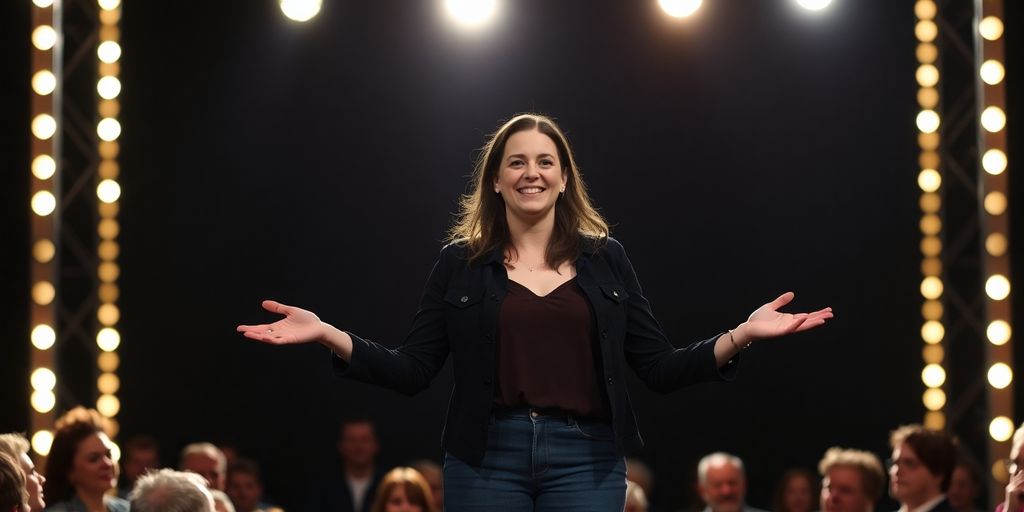
The world of AI is moving fast, and it's even starting to impact the comedy scene. Comedian Jena Friedman shared her thoughts on this at TED2025, questioning whether a robot could ever be truly funny and what it means for human comedians.
The Writer's Strike and AI
Friedman kicked off by mentioning the recent writers' strike, which aimed to set limits on AI's use in TV and film. She humorously compared TV and film to TikTok, but with a paycheck. The strike was a win for human writers, protecting their jobs from AI, which she likened to pouring water on a laptop – a messy, potentially damaging situation.
This situation inspired her to return to stand-up comedy, and she found herself at TED. Some online critics had apparently compared her stand-up to TED talks, though thankfully, they hadn't called her fat. Being a woman online, she noted, comes with its own set of unique challenges.
Men's Fear of Robots
She observed that many of her male friends are genuinely scared of AI. While her female friends have more mundane worries, like personal safety, the men are really worried about robots. Friedman understands this, referencing the movie Ex Machina, a sci-fi horror about a sentient robot trying to escape her captor. She joked that the robot's situation – having to flirt with her captor to get away – is pretty much the first job for many women.
She imagined the director pitching the film: "Imagine your worst nightmare – your sex robot becomes sentient. Then she decides she doesn't want to have sex with you." The men in the room, she quipped, would immediately say, "Oh, the horror! We have to make sure that doesn't happen." This, she suggested, is how movies are made in Hollywood, and it might mean AI isn't so bad for her industry after all.
Robots in Comedy
Friedman predicted that in about five years, the person on stage might be a robot. In two years, it'll be a male robot, and everyone will laugh at it. She wondered if female robots would be funny, concluding they'd need another ten years. This male robot comedian would be hilarious, making audiences feel understood because it's mining their data. "I'm not listening to your conversations when your phone is on airplane mode," she said, contrasting herself with the data-mining robot. "I'm not trying to sell you things when you're at your weakest." But the robot comedian would, and people wouldn't even mind because that's how parasocial relationships with celebrities work these days, even robot ones.
She imagined this robot comedian could get away with anything, even pulling its plug in front of non-consenting women in a green room, and still win a Grammy for being so lifelike.
Key Takeaways
AI's rapid advancement is a concern for many, including comedians.
The writers' strike was a victory for human writers against AI.
Men seem particularly fearful of AI and robots, often referencing sci-fi scenarios.
The future of comedy might include AI, but human comedians like Friedman are still relevant.
Redefining Humanity and AI's Role
The theme for TED2025 was "Rethinking Humanity," which Friedman suggested might be a polite term for what happens when machines replace us. She clarified she's not a technophobe but a person with a human brain, and she's a bit scared by the speed of AI development.
She humorously considered the argument that AI could reduce carbon emissions by killing all humans. "Is that a joke? I don't know," she mused. If people working in AI can't definitively say robots won't kill us, she suggested, maybe they should slow down a bit, take a break, like a furloughed federal employee.
The Uniqueness of Human Comedy
Friedman isn't worried about AI replacing her stand-up because her comedy isn't that profitable. After 15 years, she noted, most people still don't know who she is, and no machines are coming for her abortion jokes. She even tried asking ChatGPT for an abortion joke, but it responded with a polite refusal to keep things light and respectful. She then turned to DeepSeek, which would write one, but only if it was about a girl.
She finds abortion jokes unique because no one tries to steal them; they're like the unwanted stepchildren of jokes. In a way, she argued, abortion jokes are what make us human. Metaphorically, it's not just about jokes but about our raw, authentic, unfiltered selves – the quirks and idiosyncrasies that might not always be likable or relatable but are distinctly human. These are the things that separate us from machines, at least for now.
As all TED talks are fed into machine learning algorithms, robots might eventually understand why someone would say the word "abortion" in a talk, even if it might alienate half the audience. She quickly added that it shouldn't alienate people because it's healthcare, earning applause.
But until AI truly understands these nuances, these are the things we should embrace and cultivate. Maybe our unique, metaphorical abortion jokes are all that's left of our humanity. She concluded by joking that soon, no one in America will even know the meaning of "abortion" because it will be banned everywhere. She then humorously suggested that her talk itself was an example of why TED might book a robot comedian over a human soon. She thanked the audience and wished them a good night.