
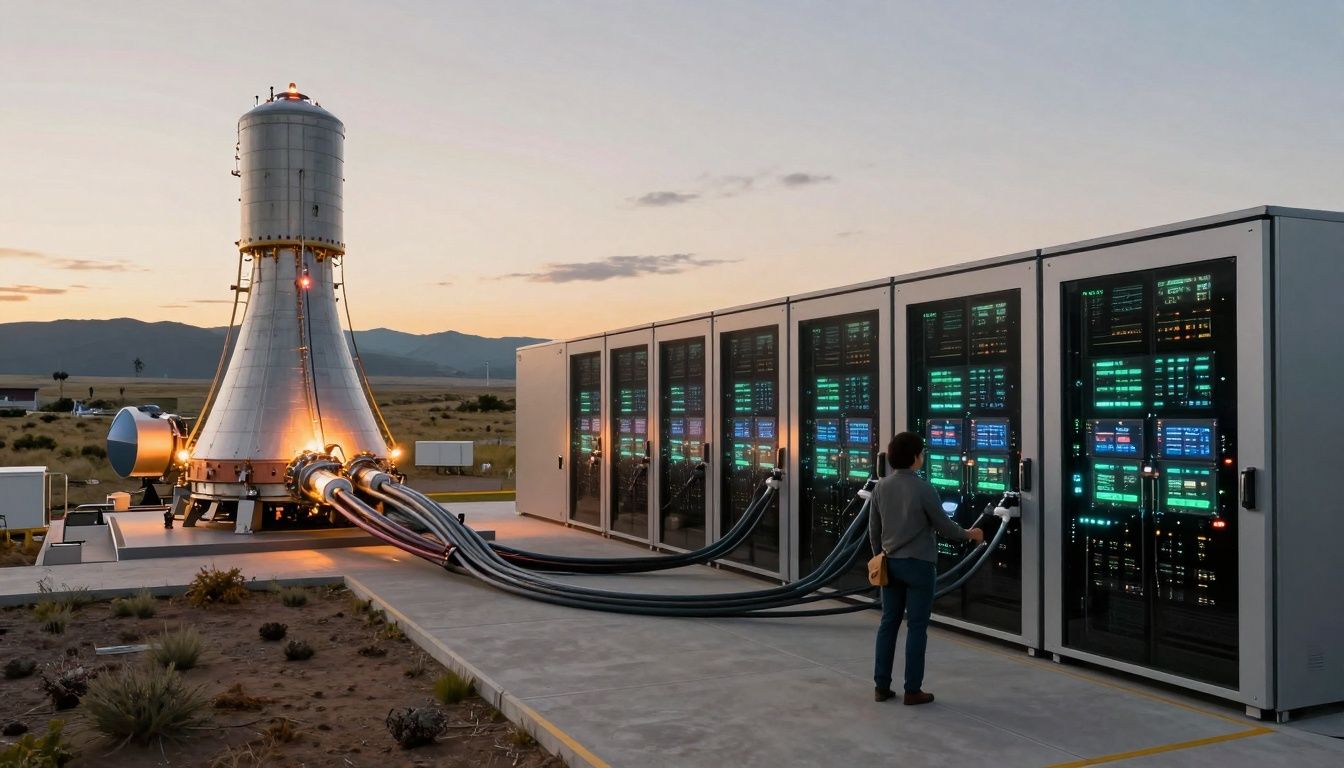

The U.S. Department of Energy is spearheading a groundbreaking initiative to integrate advanced nuclear reactors with artificial intelligence (AI) data centres. This strategic pairing aims to accelerate the development of both technologies, leveraging federal land for deployment and fostering public-private partnerships to meet the escalating energy demands of AI.
Key Takeaways
- The Department of Energy (DOE) is co-locating AI data centres with advanced nuclear reactors on federal land.
- Arizona State University (ASU) and DCX USA, LLC, have been selected for the DOE's Microreactor Application Research Validation and Evaluation (MARVEL) program.
- The initiative seeks to explore the symbiotic relationship between nuclear energy and AI, addressing power demands and accelerating nuclear deployment.
Powering the Future of AI
The burgeoning demand for AI and high-performance computing is placing unprecedented strain on energy infrastructure. Projections indicate that AI data centres could consume as much as one-eighth of the total U.S. electricity supply in the coming years, a figure comparable to the combined power usage of California and Texas. To address this, the DOE is exploring advanced nuclear reactors, including small modular reactors (SMRs), as a clean, reliable, and high-density power source.
Arizona State University and DCX USA, LLC, are at the forefront of this effort, selected as key research partners for the MARVEL program led by Idaho National Laboratory. Their joint research will focus on evaluating the capability of small modular reactors to provide dependable energy for AI workloads, generating crucial data on microreactor reliability, load-following capabilities, and stability.
Accelerating Nuclear Deployment and Innovation
The DOE's strategy involves co-locating advanced nuclear reactors with data centres on federal sites, including the Idaho National Laboratory, Oak Ridge Reservation, Paducah Gaseous Diffusion Plant, and Savannah River Site. This approach aims to streamline the deployment process for commercial industries by leveraging DOE's land assets and potentially simplifying permitting and regulatory pathways. The department intends for construction to begin by the end of the current year, with operations commencing by the end of 2027.
This initiative is viewed by proponents as a critical step towards ensuring U.S. leadership in both AI and energy technologies, with some likening the effort to a "next Manhattan Project." The symbiotic relationship is twofold: nuclear energy can provide the immense power required by data centres, while AI can potentially accelerate the timelines and reduce the costs associated with deploying new nuclear reactors.
Addressing Environmental Concerns and Community Impact
Nuclear energy is being highlighted as an attractive option for companies aiming to reduce the carbon footprint of their data centres, given its near-zero carbon emissions. However, questions remain regarding the long-term environmental and community impacts of these co-location projects. While the DOE aims to expedite development, some experts caution that the timeline for significant nuclear power contributions to data centre energy needs is still years away, leaving a gap in immediate solutions for the next five to ten years.
Furthermore, the integration of fast-moving tech firms with the more deliberate pace of government research institutions presents potential cultural differences. Nevertheless, the collaboration is expected to foster innovation in areas such as data centre design, cooling technologies, and large-scale computing, while potentially influencing data centre companies to adopt a more community-oriented approach, drawing from the established relationships national labs have with their local areas.