
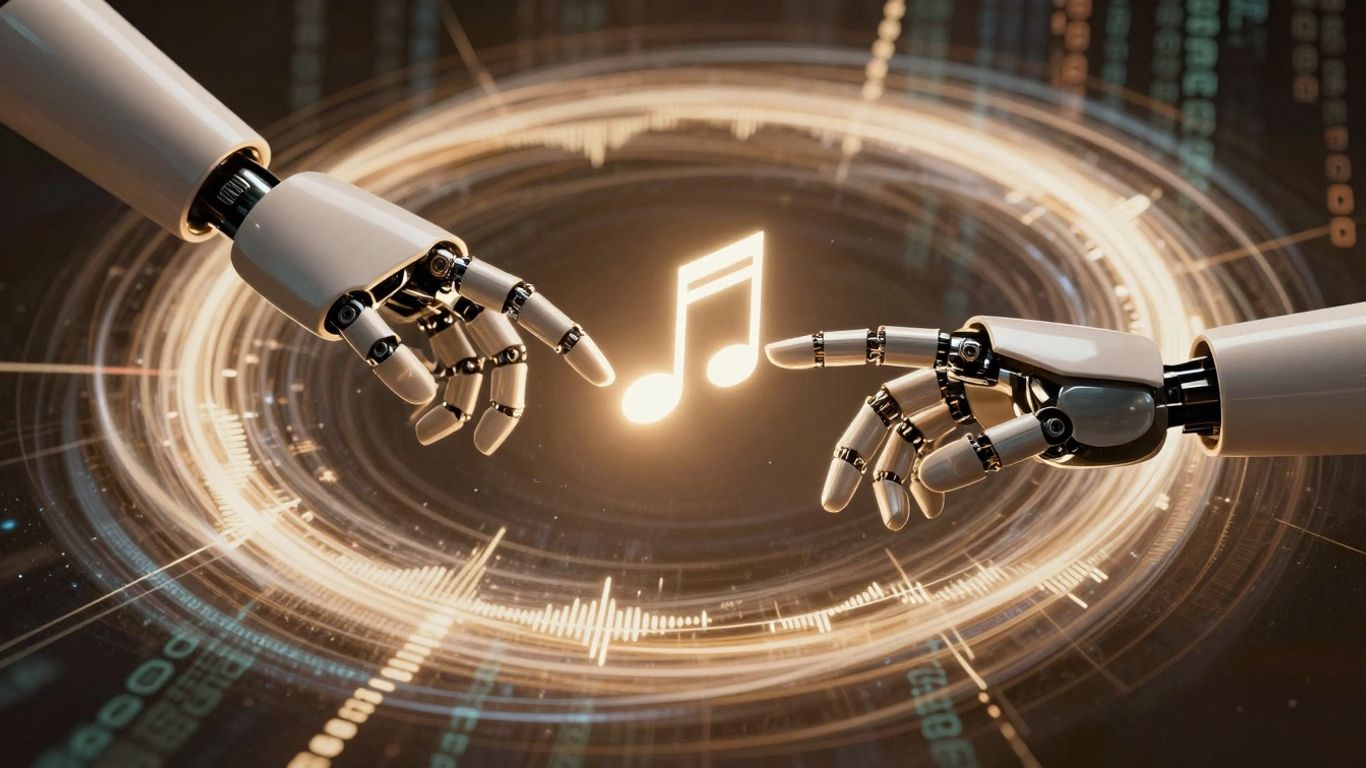

Artificial intelligence is no longer just a tool for music creation; it's now a chart-topping artist. AI-generated tracks, indistinguishable from human-made music to most listeners, are rapidly gaining popularity, raising significant concerns about authenticity, copyright, and the future of human musicians.
Key Takeaways
- A staggering 97% of listeners cannot differentiate between AI-generated and human-composed music.
- AI tracks are appearing on major charts, with virtual artists securing record deals and millions of streams.
- Concerns are mounting over copyright infringement, as AI models are often trained on existing human artists' work without compensation.
- While some embrace AI as a creative tool, many artists fear job displacement and the devaluation of human creativity.
The Rise of Synthetic Sound
Recent studies reveal that the vast majority of people are unable to distinguish between music created entirely by artificial intelligence and that produced by humans. This technological leap has led to AI-generated songs, from instrumentals to vocals, appearing on prominent music charts. Virtual artists with hyper-realistic avatars are not only gaining millions of monthly listeners on platforms like Spotify but are also being signed to record labels for substantial sums.
Listener Reactions and Ethical Quandaries
While the technical prowess of AI music is undeniable, listener reception is mixed. A significant portion of the public expresses discomfort with not being able to identify AI-generated content, raising ethical questions about its consumption. Some studies suggest a potential bias against AI music once its origin is known, while others find no significant difference in listener preference. A primary ethical concern revolves around the training data used by AI platforms, which often comprises existing human artists' work without explicit permission or payment, leading to potential copyright violations and protests from established musicians.
Artists' Fears and the Future of Creativity
For many musicians, the rise of AI represents more than just a potential loss of work; it challenges their very identity and the value of their unique skills. AI's ability to excel across genres and styles leaves some artists feeling that their special talents are no longer as distinctive. While AI can be a useful tool for ideation or production assistance, many artists, like psychologist and musician Sophia Omarji, wish to preserve music as a fundamentally human process of self-expression and creativity. Experts like Philippe Pasquier, director of the Metacreation Lab for Creative AI, argue that AI systems imitate rather than create, lacking the intentionality and framing that define human artistic expression.
Navigating the New Landscape
The music industry is grappling with how to integrate AI responsibly. Some platforms are implementing policies to identify and potentially limit AI content in editorial features, while others are exploring hybrid collaborations between human artists and AI. The debate continues on whether AI music is its own form of art or a sophisticated imitation. As AI continues to evolve, the industry faces the challenge of balancing technological innovation with the preservation of human artistry, ensuring fair compensation, and maintaining the unique connection between artists and their audiences.