
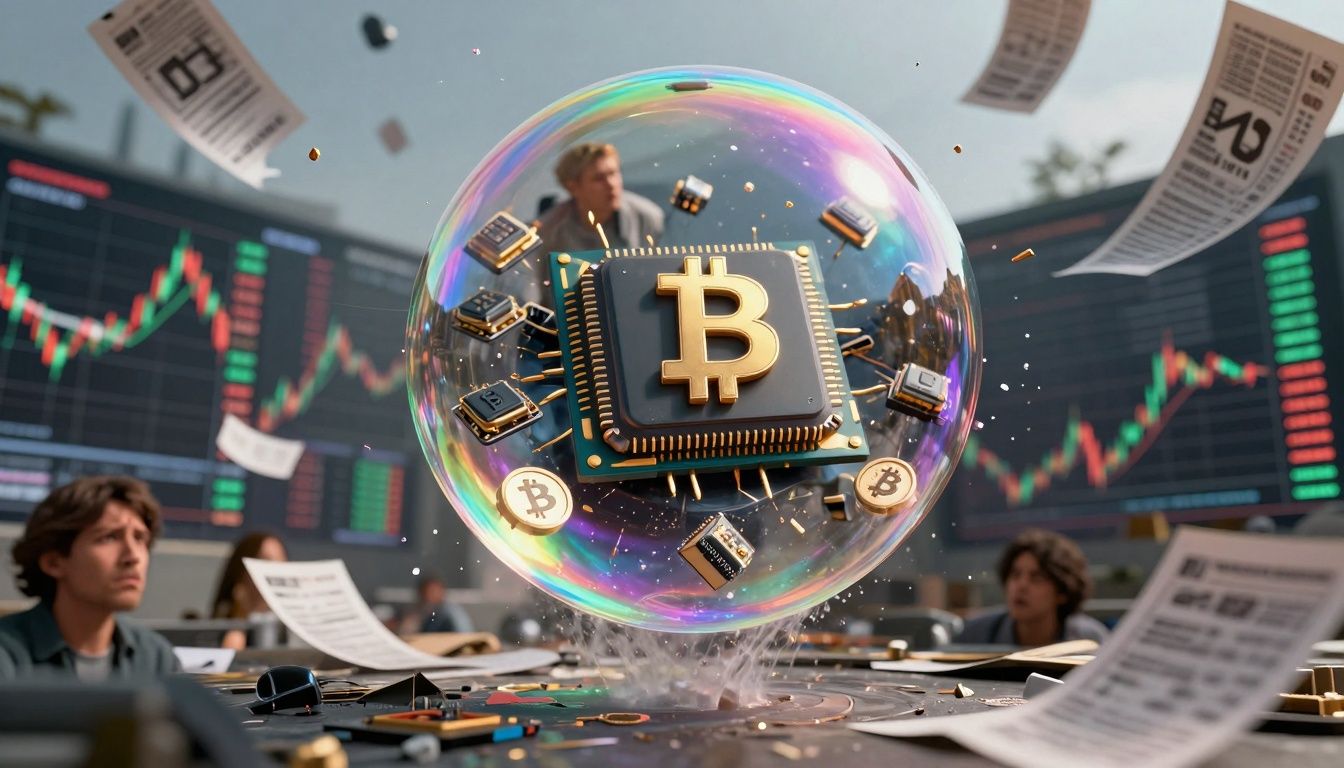
We're currently living through what might be the biggest economic bubble in history, and it's not just AI. It spans crypto and tech stocks too. Financial analyst Henrik Zeberg breaks down why this AI-crypto bubble looks a lot like past economic frenzies, driven by the same psychological forces. It seems we're repeating history, and it might not end well.
Key Takeaways
- The current AI and crypto markets show signs of a massive economic bubble, comparable to historical manias like Tulip Mania and the dot-com crash.
- Psychological factors like FOMO (Fear Of Missing Out) and crowd dynamics significantly contribute to the formation and inflation of these bubbles.
- Despite technological advancements, the market's exuberance can lead to unsustainable valuations and eventual crashes.
- Economic indicators suggest a potential recession, which historically coincides with bubble bursts and significant asset depreciation.
The Danger of Common Thinking
There's a saying, "Don't think you're special. Don't think that you know more than we do." While it might sound like common sense, this kind of thinking can be dangerous. It can lead to a collective mindset that results in hazardous outcomes. Today, we're going to talk about something a bit drier than inspirational speeches: financial bubbles, specifically concerning Bitcoin, crypto, and AI.
Voices of Caution: Buffett and Munger
When people talk about Bitcoin, you hear all sorts of things. Some praise its incredible returns. But then you hear figures like Charlie Munger and Warren Buffett, two of the most successful investors ever, calling Bitcoin "a venereal disease" or "rat poison squared." That's not my opinion; it's theirs. With their track record of millions of percent returns, it's wise to pay attention when they speak.
I myself almost invested in Bitcoin back in 2016. I was looking at putting in about $150,000, which today would be worth $20-25 million. I didn't go through with it because transferring money from a bank to a wallet was just too difficult back then. But a friend of mine did dive into crypto, specifically Ethereum, when it was just 50 cents. He held on until it hit $1,400, making 2,800 times his initial investment. We've all heard stories like this, the "Lambo guys" who jumped into something seemingly crazy and saw it skyrocket.
The Power of FOMO
This brings us to FOMO – Fear Of Missing Out. It's a deep-seated human instinct. Back when we were hunter-gatherers, being part of the group meant survival: food, safety, mates. Being outside the group was dangerous. This instinct still affects us. If we don't think like the group, we feel it's dangerous. FOMO can push us to make decisions we wouldn't normally make if we were just thinking for ourselves.
Even brilliant minds have fallen victim to FOMO. Sir Isaac Newton, one of history's greatest thinkers, invested in the South Sea bubble in the 1700s. He made money, got out, but then saw friends getting even richer. He got caught up in the FOMO, invested more, and the bubble burst. He famously said he could calculate the movement of stars but not the madness of men.
Crowd Dynamics and Historical Bubbles
Crowd dynamics play a huge role. Consider the "smoked room experiment" from 1968. In a room with eight actors and one real applicant, smoke started coming through the door. When the actors stayed put, 90% of the time, the real applicant also stayed seated, ignoring the potential hazard. But when the applicant was alone, 75% of them got up to report the smoke. This shows how the presence of a crowd changes our behaviour.
This is visible in financial bubbles too. Think of Tulip Mania in the 1630s. Tulips became an obsession, with people buying them not for their beauty but because they expected to sell them for more the next day. At its peak, one tulip bulb cost as much as a house. The bubble eventually burst.
Fast forward to 1840s Britain. The steam engine and locomotives promised to change the world, and they did. But everyone rushed in, thinking it was a guaranteed way to make money. Thousands of companies popped up, creating a massive bubble that eventually burst, leaving many people out of pocket, despite the genuinely revolutionary technology.
Then came the roaring '20s. Electrification, cars, radio – it was a time of incredible technological leaps. People thought the old world was over and a new one had begun. They FOMO-ed in, creating another massive bubble that burst, leading to the Great Depression.
And who can forget the dot-com bubble? The internet was the new revolutionary technology. Everyone jumped in, believing in the "new economy." It wasn't about profits anymore; it was about marketing spend. Wall Street and the media were all behind it, hyping companies like Webvan and Pets.com. The internet did change the world, but that didn't stop the market from crashing.
The Current AI and Crypto Bubble
Now, let's talk about Bitcoin. I believe it's the very definition of the financial bubble we're in now – an AI and crypto bubble. It reminds me of Hans Christian Andersen's story, "The Emperor's New Clothes." Two fraudsters convince an emperor that they can make clothes invisible to the stupid or incompetent. The emperor, afraid of appearing foolish, pretends to see the clothes. Everyone in the court does the same, until a child points out the obvious: the emperor is wearing nothing.
Sometimes, it takes an innocent perspective to see what's plainly obvious. Today, we have the largest financial bubble in history. The market capitalization to GDP ratio, a measure of bubble size, was 89% in 1929 and 136% in 2000. In 2007, it was 107%. Today, it's a staggering 226%.
Look at companies like Nvidia and Palantir. Nvidia's stock has risen 94,000% in 15 years. Bitcoin is up 1.2 million percent since 2012. People say it can keep going up. But we see Nasdaq and Bitcoin moving in tandem. Remember, the Nasdaq crashed 85% after 2001, and that bubble was much smaller than today's.
The Looming Recession
We're also seeing clear signs of an economic slowdown. Unemployment levels in the US are rising, and historically, when unemployment goes up, a recession follows. Recessions are when bubbles burst. And when a bubble bursts, assets that have inflated unsustainably get hit hard.
If a recession is coming, and we've seen Nasdaq drop 85% before, what happens when we have an even bigger bubble today? I believe Bitcoin and crypto are in a massive bubble. It's not that the technology isn't real, just like the steam engine or the radio. But that doesn't guarantee returns. I think this bubble is going to burst, and Warren Buffett and Charlie Munger are right: Bitcoin and crypto, in this context, are like a venereal disease.
Financial analyst Henrik Zeberg