
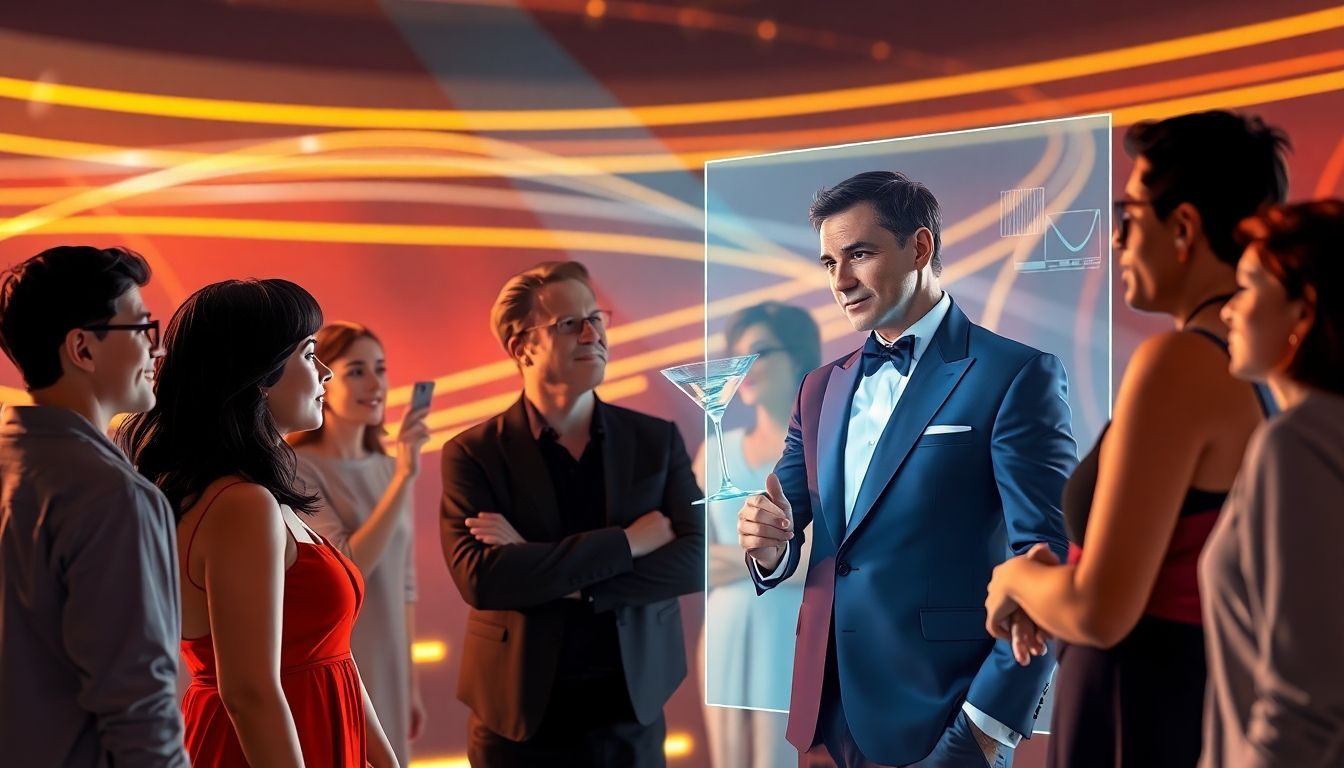
Imagine a world where you don't just watch a movie, but you actually talk to the characters and help shape the story. AI engineer Christoph Lassner envisions this future of entertainment, where generative AI allows viewers to become co-creators of interactive stories. This shift could fundamentally change how we experience media.
Key Takeaways
- Content is evolving from something we passively consume (Content 1.0) to something we upload (Content 2.0), and now to something we actively create with (Content 3.0).
- Generative AI models, trained on vast amounts of data, can understand, reproduce, and create content across various formats like text, code, images, music, and even video.
- This technology opens doors to new forms of storytelling, interactive worlds, and experiences where viewers can engage directly with characters and narratives.
- The creation process will shift, with producers focusing on setting the stage – the world, characters, and backstories – while viewers co-create the ongoing narrative.
- While initial attempts might be rough, the potential for deeply engaging and personalized entertainment experiences is immense.
The Evolution of Content: From 1.0 to 3.0
We can break down the evolution of digital content into three main stages. Content 1.0 is what we're used to: professionally created content like books, music, films, and games. These are typically expensive to produce and are made by teams of people aiming to reach a broad audience. Think of it as the traditional media we've consumed for decades.
Content 2.0 is the personal content, the kind you likely upload yourself. This started with simple homepages and blogs and has grown into the social media landscape we know today, where billions of people create and share content. The sheer volume of data generated is staggering – over 100 zettabytes are expected to be created in 2025 alone. To put that into perspective, if a high-definition camera recorded 3 gigabytes per hour, it would take nearly 3.8 billion years to record that much data.
Content 3.0, however, is where things get really interesting. This is content that is generated by you, or rather, with you. It's made possible by generative AI models that can understand and create content based on the massive datasets they've been trained on. These models aren't just limited to text; they can generate code, images, music, and increasingly, video.
Building Interactive Worlds with AI
Imagine not just watching a movie, but being able to explore its entire world from every angle. This is the direction Christoph Lassner is working towards with World Labs. They are building systems that allow interaction with spatial intelligence, enabling AI to understand, reason, and generate spatial data. The virtual rooms and environments you see are not real; they are created by AI, sometimes from a single image. This opens up possibilities for artists, developers, and anyone looking to explore fantastical environments.
These AI models learn to understand 3D worlds by processing vast amounts of data, like videos of people walking through real-world locations. This spatial understanding allows them to generate and explore these virtual environments.
New Frontiers in Storytelling
While AI-generated content can be used to create more of Content 1.0 and 2.0 – like instantly generating your dream movie or turning a simple video into a professional clip – Lassner believes this doesn't tap into the full potential. He dreams of new kinds of storytelling, interactive worlds, and experiences where we can interact with characters in more natural ways and explore worlds without artificial limits. The narratives wouldn't be predetermined.
This is a significant leap from traditional gaming, where stories and characters are pre-written. With Content 3.0, the story can evolve dynamically between the world and each individual viewer. Characters could even break the fourth wall, having meaningful conversations with viewers, offering hints, or receiving new ideas to change the plot.
Think about it: James Bond might ask you for advice on where to find the villain, or perhaps even chat about his favourite martini. This opens up an entirely new, unexplored medium.
The Shifting Economics of Content Creation
Content 1.0 involves producers creating content once for the largest possible audience, with high upfront costs. Content 2.0 sees viewers becoming producers, with many smaller content pieces at lower costs, often supported by advertising. The social network handles distribution and matches content to the right audience.
Content 3.0 has the potential to change this equation again. Producers can focus on creating the framework – the world, the characters, their backstories, and their attitudes. The actual content is then co-created with each viewer in real-time, blurring the lines between linear media like films and interactive media like games. While initial attempts might be rough and perhaps even awkward, it took decades for films and computer games to reach their current state. The economics of dynamic, on-the-fly generated experiences will likely be very different, with potentially higher costs per viewer for these fully dynamic experiences.
The Future is Collaborative
In summary, Content 1.0 is viewed by you. Content 2.0 is uploaded by you. Content 3.0 is created by you, or with you. From now on, you'll likely be in the story, or interacting with it. The best storytellers will always use the best tools available, and Content 3.0 offers a completely new set of tools that we are only just beginning to understand. A new generation of artists will show us what's possible with this exciting evolution.