
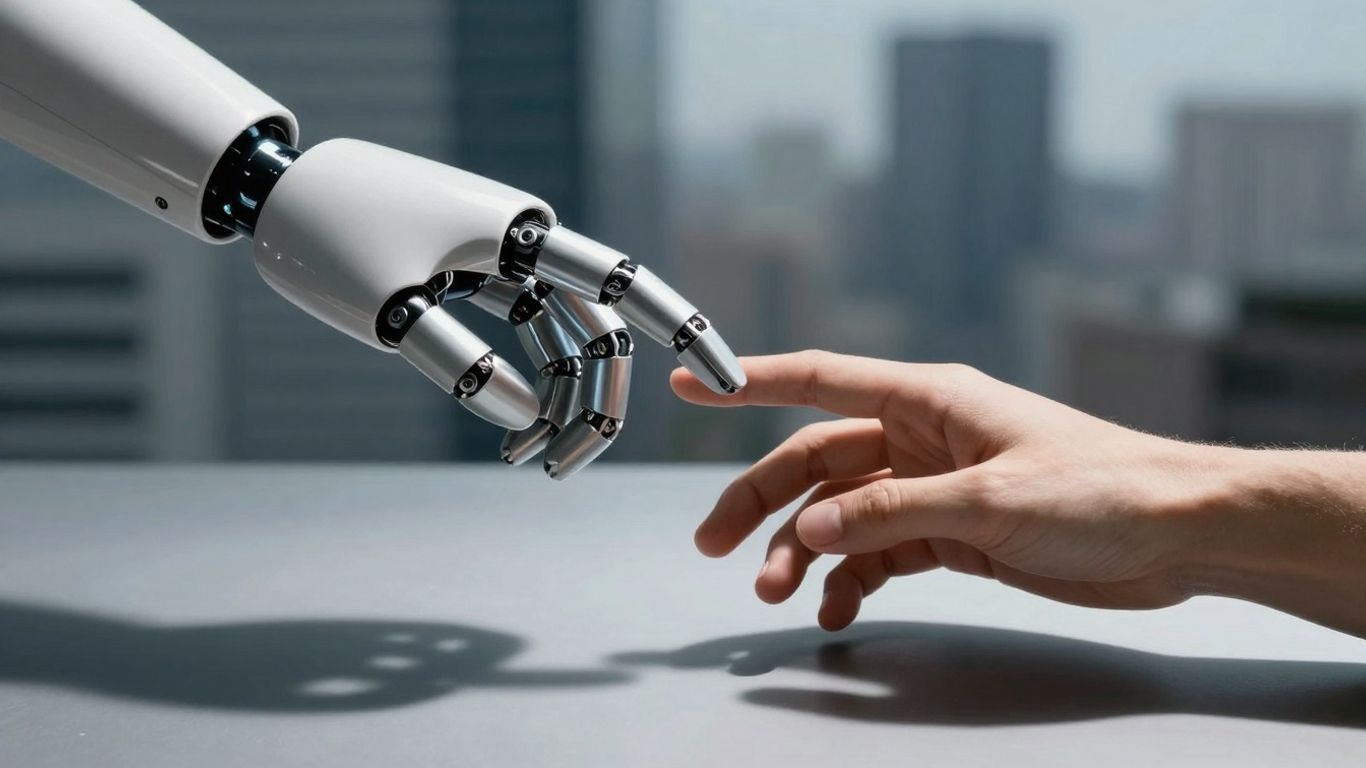
The rapid advancement of Artificial Intelligence has sparked widespread anxiety about the future of work. As AI capabilities grow, many jobs we know today might disappear. This piece explores historical parallels and offers a perspective on how humanity has adapted to massive job disruption before, suggesting a future filled with new opportunities, albeit in forms we might not yet imagine.
Key Takeaways
- Job disruption isn't new; it's a constant feature of human evolution.
- Technological advancements have historically led to the creation of more, and often better, jobs.
- AI might accelerate job displacement, but it also promises an explosion of new roles and entrepreneurial ventures.
- The nature of work may shift towards activities that feel more like leisure or creative pursuits.
- Humanity's capacity for adaptation and meaning-making will be key to navigating this transition.
A Look Back: Job Disruption Through History
Think back to when you were 20. Where were you? What did you want to do? For many, the career path isn't clear. Now, imagine that path becoming even more uncertain. When the speaker was 20, graduating with a degree in pure mathematics, the 2008 financial crisis hit. Many friends, especially those who felt financially secure, found themselves unemployed. Amidst this uncertainty, the iPhone and App Store emerged, creating a new, level playing field and sparking technological optimism. This blend of economic hardship and technological hope shaped the speaker's career.
Today, the fear is different. The emerging technology isn't a cure; it's the source of anxiety. People wonder if their chosen careers will exist in 10 years. Unlike the iPhone, AI is a tool whose limits we don't yet understand. The speaker founded a company to build super-mathematical AI, capable of outthinking any mathematician. This raises a profound question: what do we do in a world where most of today's jobs disappear?
To answer this, we can look at history. For tens of thousands of years, during the Paleolithic era, jobs like hunters, gatherers, and toolmakers were dominant. These roles didn't vanish overnight but evolved into more specialised jobs. Fast forward to the Neolithic era, with the advent of agriculture and animal husbandry. This shift allowed for more creative work, leading to new professions like weavers, potters, and builders. These jobs, too, have largely disappeared. In the US today, farmers make up less than 2% of the workforce.
We've seen this pattern through the Bronze Age, Iron Age, Renaissance, and Age of Exploration. Jobs like blacksmiths and explorers, once common, are now rare. Even common surnames reflect past professions: Potter, Butler, Butcher, Smith. The speaker's own family history shows this evolution, from a farmer ancestor to a tourism professor. This suggests that job disruption is a fundamental aspect of human progress, driven by our desire to make life easier and earn more per hour of work.
The Accelerating Pace of Change
While job disruption itself isn't new, the speed and acceleration of AI-driven change might be what's causing so much unease. In the 20th century, following industrial expansion and automation, young people found entirely new categories of jobs, like office work, which their parents couldn't have imagined. The internet era brought further transformation, creating roles that didn't exist before.
So, where does this leave a 20-year-old today at the dawn of the AI age? A recurring theme across generations is a sense of exceptionalism – the belief that we are in an unprecedented era. While it's true we don't know if we're building a super-assistant or a super-predator, history shows a consistent trend: new jobs emerge. AI researchers talk about the singularity, but data suggests we're also on a curve of accelerating job creation, a "job singularity." This could be a Cambrian explosion of new job families in every conceivable field.
The Future of Work: Beyond Traditional Jobs
Just as the internet gave people global access, AI is providing world-class employees. The jobs of the future might not look like "work" as we know it. Many roles could resemble entertainment. We might see people paid for playing video games, dining at restaurants, travelling, or even video-chatting with friends – the "podcast bros." While these roles might seem like leisure, they represent a significant shift in how we define and value work.
If someone from the 20th century could see our world today, they might believe all predictions about "technological unemployment" had come true. Yet, we continue to find meaning and purpose. The speaker is confident that future 20-year-olds, perhaps collaborating with AI, will continue to build new things. We will likely be both scared and excited by these creations, just as we have been throughout history.
Navigating the AI Transition
While there will be many jobs to choose from, and they might feel like entertainment, humanity has the creativity to navigate this potential scenario. Our constant worry about threats to our existence is part of our survival mechanism and what makes us human. Don't let predictions of job disruption prevent you from pursuing something you are passionate about.
Consider the 1990s: teachers didn't encourage programming careers, fearing jobs would be outsourced. Around the same time, AI beat Garry Kasparov at chess, an activity once thought to be purely human intellectual domain. Yet, the chess industry is now thriving. Sometimes, our predictions about the future are completely wrong.
Humanity has always excelled at finding meaning and purpose, even in uncertain times. It's highly likely that future generations, possibly in collaboration with AI, will continue to build new things. We will likely feel a mix of fear and excitement, a familiar human response to profound change.