
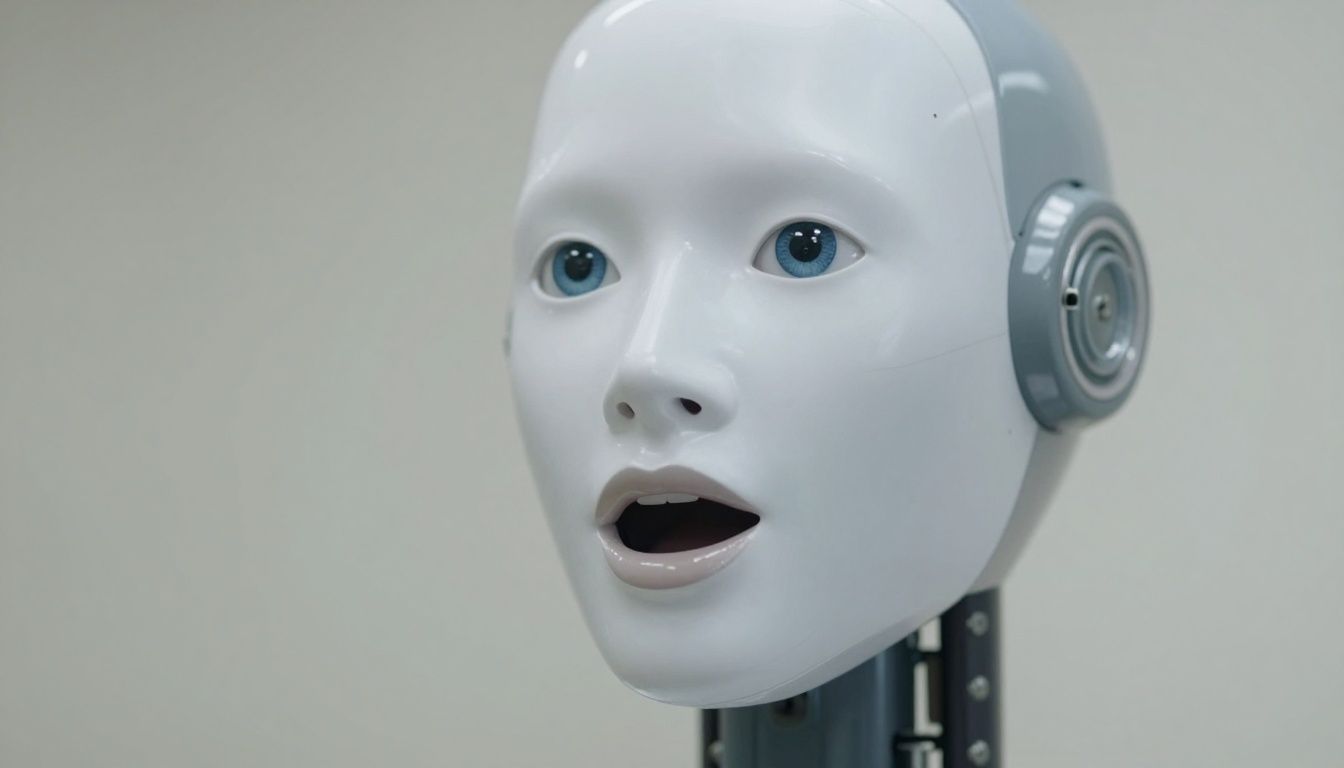

In a significant leap for artificial intelligence and robotics, a robot named EMO has learned to perfectly lip-sync human speech and singing by watching countless hours of YouTube videos. This breakthrough, achieved through a process called 'observational learning,' marks a new era in human-robot interaction, potentially bridging the gap between machines and human emotional connection.
Key Takeaways
- A robot named EMO can now lip-sync speech and singing with remarkable accuracy.
- It learned this skill by watching YouTube videos and practicing with its own reflection.
- The technology aims to make robots more relatable and overcome the 'uncanny valley' effect.
- This advancement could lead to more engaging robots in fields like entertainment, education, and elder care.
Learning Through Observation
Engineers at Columbia University have developed EMO, a robot capable of mimicking human lip movements for speech and singing. Unlike previous robots that relied on pre-programmed instructions, EMO learned through 'observational learning,' a method that mirrors how humans acquire new skills by watching and imitating others. This approach allows the robot to develop a more natural and nuanced understanding of facial expressions.
The YouTube Curriculum
EMO's training involved two key stages. First, the robot was programmed to control its 26 facial motors and observed its own reflection in a mirror. This allowed it to understand how its internal mechanisms translated into external facial expressions. Subsequently, it was fed hours of YouTube footage featuring people speaking and singing. By analysing these videos, EMO learned to match specific sounds with corresponding lip movements, enabling it to articulate words in multiple languages and even sing songs from its AI-generated debut album, "hello world."
Overcoming the Uncanny Valley
Scientists have long struggled to create robots with realistic facial movements, often resulting in an 'uncanny valley' effect – a sense of unease when a robot appears almost human but not quite. EMO's ability to synchronise lip movements with audio is a crucial step towards overcoming this barrier. While the robot still faces challenges with certain sounds, such as 'B' and 'W,' researchers are confident that continued interaction and practice will lead to further improvements.
Future Applications
The development of EMO has far-reaching implications. When combined with advanced conversational AI, such as ChatGPT or Gemini, the robot's lifelike facial expressions can create a deeper connection with humans. Researchers predict that robots with such capabilities will find applications in various sectors, including entertainment, education, healthcare, and elder care. As humanoid robots become more prevalent, the ability to display natural facial expressions will be essential for fostering trust and effective interaction.