
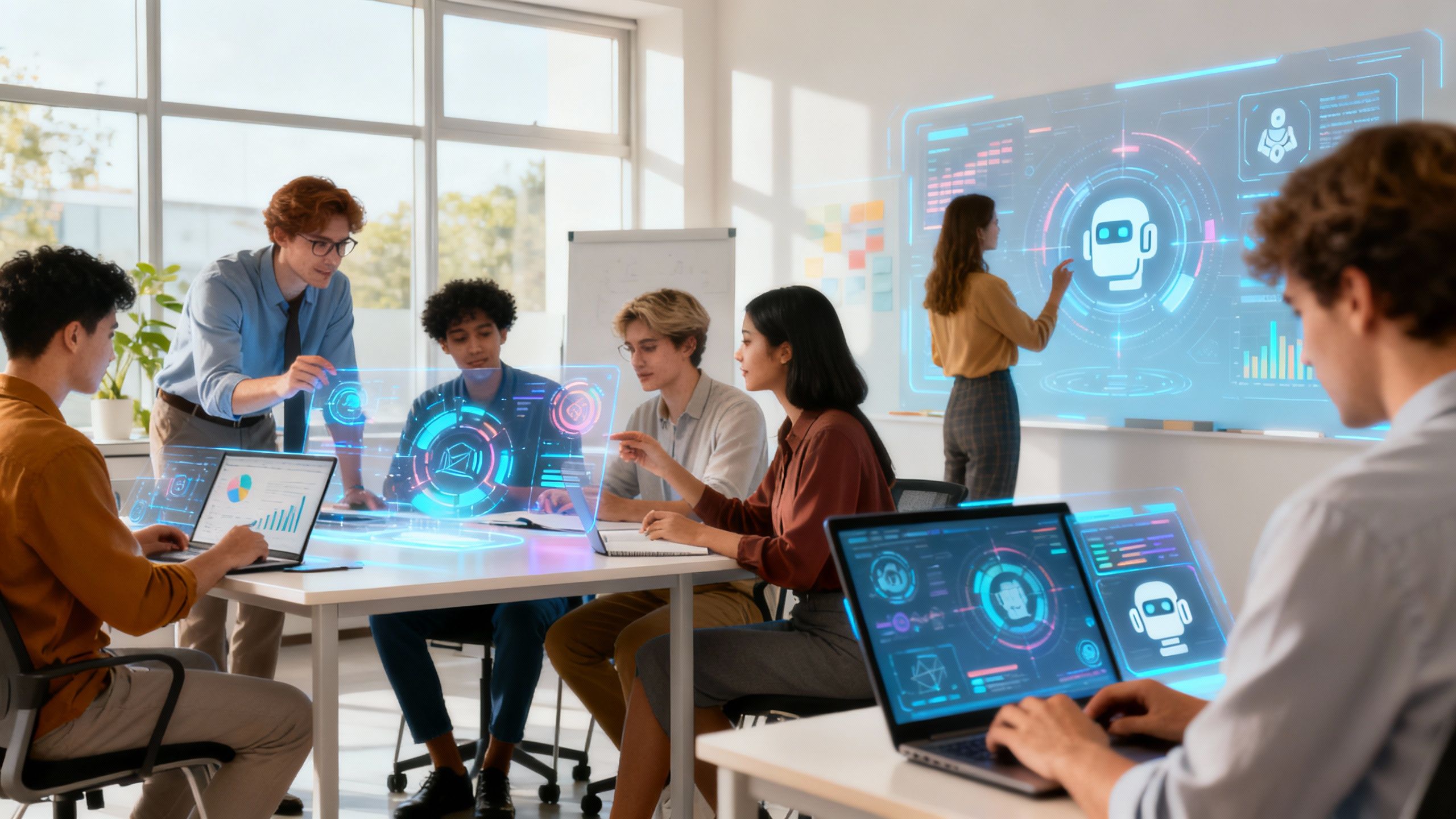

The rapid integration of Artificial Intelligence (AI) into the global economy is fundamentally reshaping the nature of work. As AI technologies advance at an unprecedented pace, workers across all sectors are increasingly focusing on upskilling and reskilling to adapt and remain relevant in this evolving landscape. This proactive approach is crucial for navigating the challenges and seizing the opportunities presented by the AI era.
Key Takeaways
- Adaptability is Paramount: The speed of technological change necessitates continuous learning and a willingness to acquire new skills throughout one's career.
- Human Skills Remain Crucial: While AI excels at routine tasks, uniquely human capabilities like creativity, emotional intelligence, ethical judgment, and complex problem-solving are becoming more valuable.
- Collaboration is Key: The future of work lies in human-AI symbiosis, where technology augments human potential rather than replacing it.
- Proactive Strategy is Essential: Individuals, businesses, and governments must adopt strategic approaches to education, training, and regulation to navigate the AI transition successfully.
The AI Transformation of Work
Artificial intelligence is no longer a distant concept but a defining feature of the modern economy. From healthcare and finance to creative industries, AI is accelerating change at a pace unmatched by previous technological revolutions. This transformation is not merely about automation; it's about redefining job roles and the skills required to perform them. Projections suggest significant shifts in the job market, with some roles becoming obsolete while new ones emerge, demanding a workforce that is agile and continuously learning.
Upskilling and Reskilling as a Necessity
The shrinking half-life of skills—information becoming outdated more quickly than ever before—underscores the critical need for upskilling and reskilling initiatives. As businesses adopt AI tools, the skills their workforce needs are rapidly changing. Organisations that invest in developing their employees' capabilities in areas like AI literacy, critical thinking, and interpersonal skills are better positioned to remain competitive. This focus on human-machine collaboration aims to enhance productivity and value creation.
The Enduring Value of Human Skills
While AI can process vast amounts of data and perform routine tasks with remarkable efficiency, it cannot replicate uniquely human qualities. Creativity, imagination, emotional intelligence, ethical judgment, and complex problem-solving remain the domain of humans. These skills are becoming increasingly valuable as AI takes over more predictable tasks. The future of work will likely see a rise in roles that leverage these human-centric strengths, fostering a symbiotic relationship between humans and AI.
A Coordinated Approach to the Future
Navigating the AI revolution requires a concerted effort from individuals, businesses, and governments. Individuals must adopt a lifelong learning mindset, prioritising human-centred skills and learning to leverage AI as a partner. Businesses need to integrate AI into their core strategies, invest in human-AI collaboration, and foster innovation. Governments play a crucial role in establishing proactive regulations, launching national reskilling missions, and providing social safety nets to support workers through the transition.
Embracing Human-AI Symbiosis
The future of work is not a competition between humans and machines but a collaboration. By moving beyond the fear of replacement and embracing human-AI symbiosis, we can unlock new levels of productivity and innovation. Cultivating distinctly human capabilities while mastering AI fluency will be key to thriving in this new era. The challenge lies in becoming more human, not less, in a machine-driven world.