
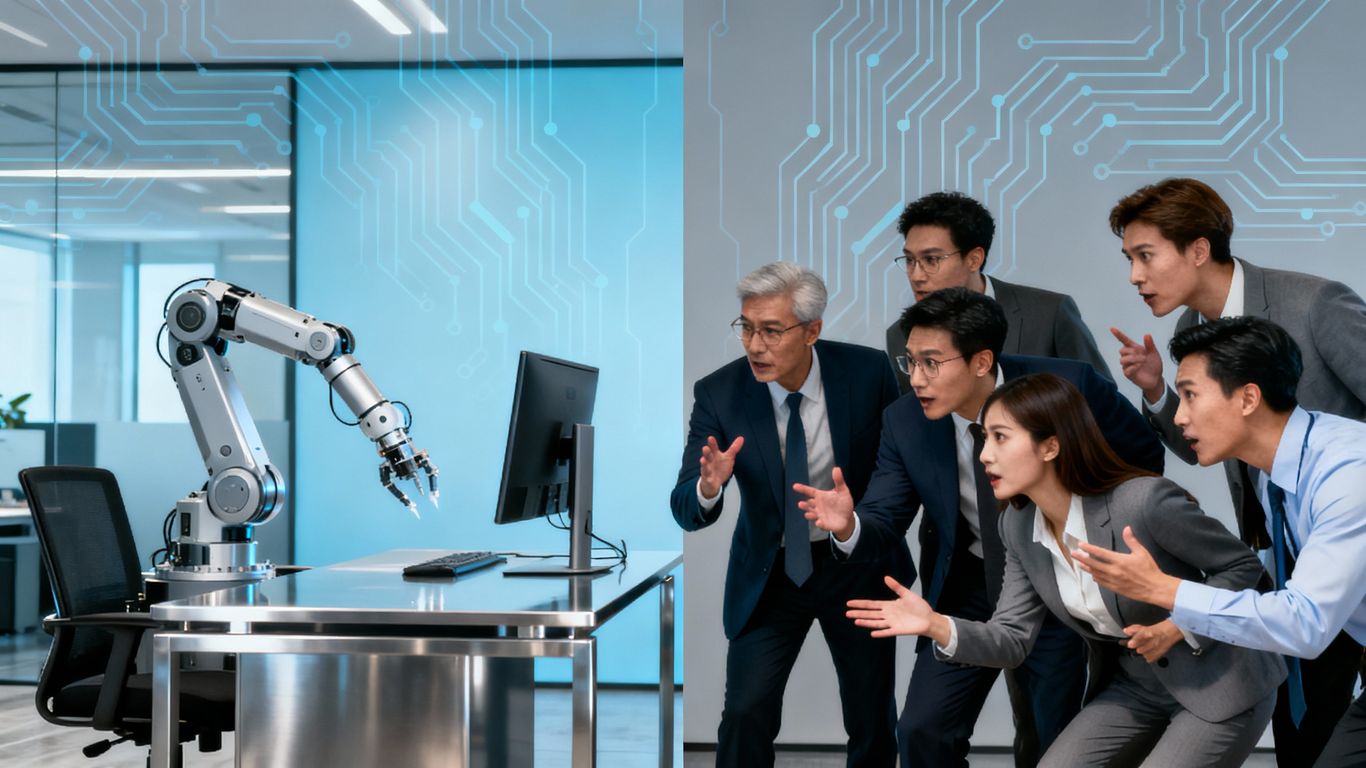

Tech industry leaders are divided on the potential impact of artificial intelligence on white-collar jobs. While some foresee widespread job displacement, others argue that AI will augment human capabilities, leading to job expansion and economic growth. This divergence of opinion highlights the uncertainty surrounding AI's transformative power.
Key Takeaways
- Some prominent figures predict significant job losses, particularly in entry-level roles.
- Others believe AI will create new opportunities and increase overall productivity.
- Historical parallels suggest technological advancements often lead to job reinvention rather than outright elimination.
The Pessimistic Outlook
Concerns about AI's impact on the labour market are mounting. Kristalina Georgieva, head of the IMF, has described AI's arrival as a "tsunami" for employment. Jamie Dimon, CEO of JPMorgan Chase, has indicated that the bank may require fewer employees in the future. Furthermore, Dario Amodei, CEO of Anthropic, has predicted that AI could eliminate "half of all entry-level white-collar jobs" within the next one to five years, potentially spiking unemployment to 10-20%.
The Optimistic Counterpoint
Conversely, many industry leaders view AI as a catalyst for growth and job creation. Aaron Levie, CEO of Box, argues that AI will lower the cost of knowledge-based tasks, enabling companies to undertake more projects and thus expand their workforce. He draws parallels to the Jevons paradox, where increased efficiency in resource use led to higher overall consumption. Levie believes AI will target non-deterministic tasks, which require judgment and creativity, making them more accessible and scalable.
Similarly, Google's CEO suggests that AI will act as an "accelerant" rather than a cause for job cuts. This perspective posits that AI will augment human workers, making them more productive and leading to the creation of new roles and industries, much like the internet did in the late 20th century. Historical precedents, such as the rise of the internet, show that while some jobs are displaced, new ones emerge, often in unforeseen areas like software development and digital marketing.
Reinventing Work, Not Eliminating It
Many experts believe that AI will fundamentally reshape the nature of work rather than lead to mass unemployment. They point to the fact that previous predictions of technological job collapses have often proven exaggerated. For instance, the rise of e-commerce, initially feared to decimate retail jobs, instead transformed the sector into a logistics-heavy industry that created new, often better-paid, roles in fulfillment and delivery. AI is expected to follow a similar path, automating routine tasks and freeing up human workers for more complex, creative, and strategic endeavours. The adoption of AI is also likely to be a gradual process, taking years to integrate fully into business operations, allowing for adaptation and the development of new skill sets.
Broader Economic Implications
Beyond job numbers, AI holds the potential to address pressing societal needs. By modernising sectors like healthcare, childcare, and elder care, AI could significantly lower the cost of essential services and improve living standards. Furthermore, the integration of AI with robotics could boost productivity in physical industries. While regulatory oversight is necessary, the overall outlook for AI's impact on the job market is viewed by many as positive, promising increased productivity and potentially higher real wages.