
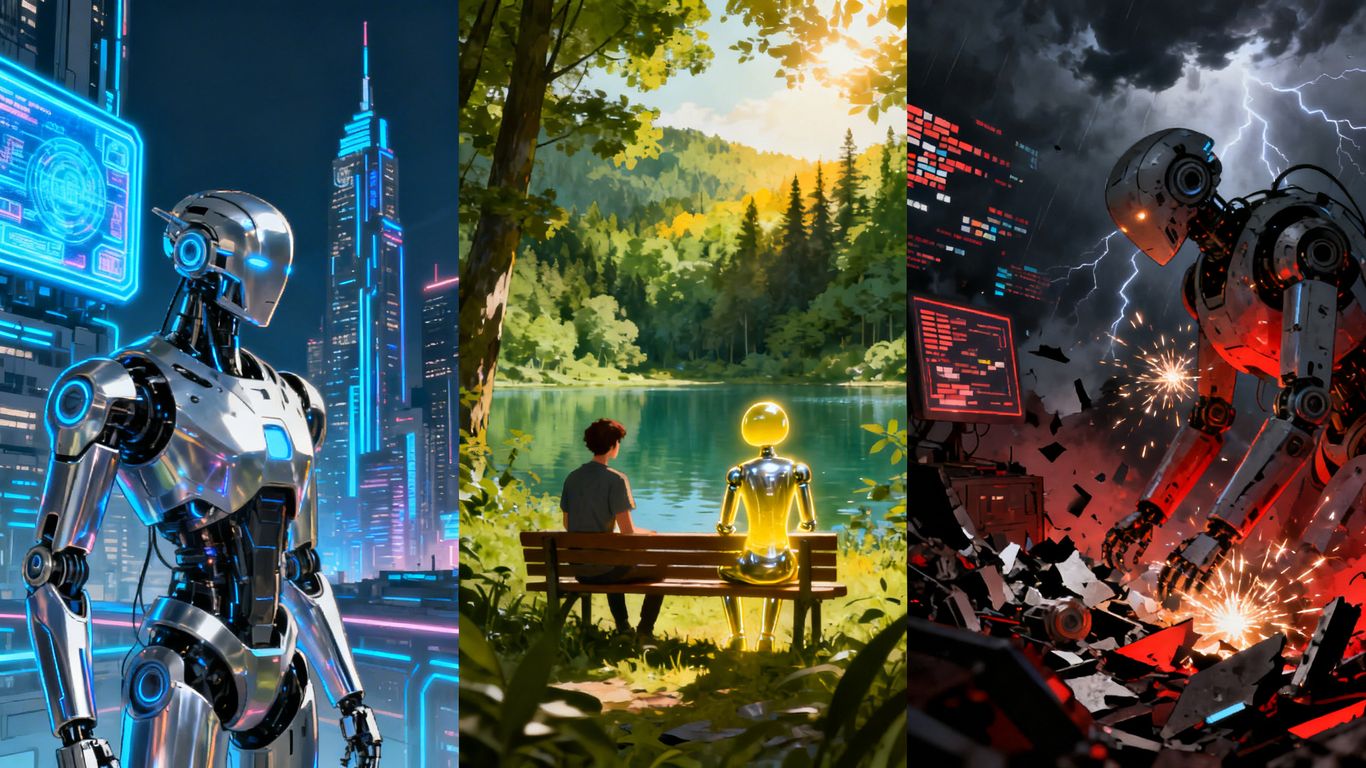
Artificial intelligence is advancing at a breakneck pace, leaving many wondering about its ultimate impact. Alvin W. Graylin, with decades of experience in tech across the US and China, presents a sobering look at three potential futures for AI, urging us to consider the path we're currently on and the choices we need to make.
Key Takeaways
- We are at a critical juncture with AI, facing three possible futures: a "Elysium" where tech giants create immense wealth for a few, a "Mad Max" scenario of escalating global conflict, or a "Star Trek" future of shared technological progress for the common good.
- The narrative that AI development must be accelerated to beat China is a myth used to secure funding and deregulation, rather than a genuine concern for global safety.
- To steer towards a positive future, we need global collaboration on AI research (like a "CERN of AI"), the aggregation of worldwide data to reduce bias, and a "GI Bill for the AI Age" to support those displaced by automation.
- Individuals and businesses must actively engage with AI, understand its capabilities, and focus on integrating it to augment human work rather than simply replace it, preparing society for rapid technological change.
The Crossroads of AI
It's easy to feel overwhelmed by the rapid advancements in AI. Many of us are unsure what's real and what's just hype. Alvin W. Graylin, who has spent 35 years working in AI, cybersecurity, and VR, both in the US and China, believes we're at a significant turning point. He suggests we're not just on a steady upward trend, but rather at a fork in the road, with three very different futures ahead of us.
Future One: The "Elysium" Scenario
In this future, large tech companies, by accumulating vast power and resources, essentially take control of governments. This leads to the creation of a small class of trillionaires, while the rest of the population is left behind. Think of it as a futuristic, technologically advanced version of extreme inequality.
Future Two: The "Mad Max" Scenario
This path sees escalating conflict between nations. The current "AI race" could easily spill over into actual AI warfare, and potentially even kinetic or nuclear conflict. Some people in positions of power actually see this as an inevitable outcome, which is a pretty scary thought.
Future Three: The "Star Trek" Scenario
This is the optimistic vision. It's a future where technology is developed and shared for the benefit of all humanity. In the Star Trek stories, advanced civilizations share their technology peacefully, helping others to progress. We have the potential to reach a similar era of discovery and advancement, but it requires conscious effort.
Unfortunately, Graylin points out, we are currently heading towards the first two scenarios. Moving towards the third, more positive future will require significant work.
Debunking the "China Threat" Myth
One of the narratives we often hear is that AI development needs to be rushed and locked down, with a strong emphasis on beating China to the punch. Graylin calls this one of the biggest myths out there. He explains that the AI industry, much like the military-industrial complex of the past, uses the idea of an "enemy" to gain funding, support, and deregulation. The real goal for many AI labs isn't to save the world, but to make trillions of dollars. They aim to be the first to create Artificial General Intelligence (AGI), defined as a technology that can replace the average human worker. While this could theoretically liberate us to pursue art and music, the crucial missing piece is how we protect those whose jobs will be displaced.
Charting a Course for a Better Future
Graylin, despite the stark warnings, is an optimist. He has outlined a three-part plan to steer AI development in a more positive direction:
- Global Collaboration: Instead of hundreds of labs duplicating efforts and competing for scarce resources like chips and talent, we should create a single, collaborative research hub, akin to the "CERN of AI" or the International Space Station. This lab would aggregate global talent, and its discoveries would be shared openly, following the principles of open science that have driven progress for decades.
- Unified Data Approach: We need to combine data from around the world. The concept of "sovereign AI," designed to work only for a specific country or culture, is problematic. Research shows that limiting data leads to more biased AI. By including the entire world's data – our history, languages, and cultures – we can create AI that is optimal for everyone, balancing needs without disadvantaging others.
- The "GI Bill" for the AI Age: Just as the US implemented a GI Bill after World War II to support returning soldiers with education and housing, we need a similar program for the AI era. With potentially millions, even billions, of people displaced by automation globally, we must provide support like free education, zero-interest loans, and healthcare. This isn't just about compassion; it's about preventing societal unrest and ensuring a stable future.
Taking Action in the AI Age
So, what can we do as individuals and businesses? Graylin urges us to shift our mindset. The world isn't a zero-sum game. Working together is enlightened self-interest because it lifts everyone up, reducing the potential for conflict. This incredible technology has the potential to solve major global problems like cancer, energy shortages, and hunger, but only if we choose to share it and use it for humanity's good.
For business owners and senior professionals, the focus should be on integrating AI to augment human capabilities, not just replace workers. Instead of immediate layoffs, consider options like four-day workweeks or reskilling employees. The pace of AI advancement is far faster than previous industrial revolutions, and our society needs to adapt quickly.
Finally, Graylin stresses the importance of personal engagement. You have to use these AI models yourself. Don't just listen to what others say about them. The more you interact with them, the more you'll understand their power and how rapidly they are evolving. If you don't use them, you won't truly grasp what's happening.